Tuesday, July 24, 2007

The Big Aviation Picture - The Air Travelers Future Page 2

Hi Readers:


This is the second page of the above titled blog. I felt that all the blog data in one page was too much for the short-term viewing, therefore two pages. Keep in mind that FAA's 2006 flying hours contain some estimation.

__GA Safety Record__

...........................1986...............2006

Total Accidents...........2,581..............1,764
Fatal Accidents.............474................334
Fatalities..................967................600
Hours Flown (000s).......27,073.............24,401
Accident Rate (per 100,000 hours flown)
...........................9.18...............6.64
Fatal Accident Rate........1.63...............1.32


___ Air Carrier Safety Record ___

...........................1987...............2006

Total Accidents..............32.................25
Fatal Accidents...............4..................2
Fatalities..................231.................50
Hours Flown (000s).......10,115.............18,900
Accident Rate (per 100,000 hours flown)
..........................0.306..............0.132
Fatal Accident Rate.......0.030..............0.011


Flight hours are compiled by the FAA.

Between 1987 and 2006 the hours flown showed a steady increase.


_____________________AC Part 135 Operation__

...........................1987...............2006

Total Accidents..............33..................3
Fatal Accidents..............10..................1
Fatalities...................59..................2
Hours Flown (000s)........1,946................280
Accident Rate (per 100,000 hours flown)
..........................1.695..............1.071
Fatal Accident Rate.......0.514..............0.357


The in-between years accidents varied from 7 to 23.

From 1987 through 1996 the flight hours increased slightly, and in 1997 the flight hours started dropping to a low of 280,000 in 2006.

The analysis of the GA accident data for 2006 and 2007 for accident causes, phase of flight, type of flying, and pilot-related factors will be forthcoming in future blogs, depending on the completion progress of NTSB Investigations.


Safe flying to all!
RS.


Sunday, July 22, 2007

Aviation's Big Picture - The Air Travelers Future


Hi Readers:

Let's take a good look at the total aviation picture of General Aviation (GA) and Air Carrier (the Airlines) to see how we have performed in the past and what is indicated for t he future, particularly for the air traveler. I have taken figures comparing 1986 and 2006, two representative years following the deregulation of the Airlines by the Civil Aeronautics Board (which was abolished in its entirety in 1984). The figures are as stated, researched from the FAA, Department of Transportation, NTSB, NBAA, and the ATA. I must say that the effort to get factual figures was not easy. 1990 was the first year of Recreational Flying, and 2005 was the first year of Sport Flying - therefore, they are not covered here.


___Certificated Pilots___


...........................1986...............2006

Students................150,273.............91,200
Private.................305,736............243,300
Commercial..............147,791............126,900
Air Transport Pilot-ATP..87,186............146,000
Helicopter................8,581..............8,830
Flight Instructor-CFI....57,355.............91,343
Other *..................18,125.............21,210
Total...................709,118............637,440
* The Other category represents Glider, Balloon, and Lighter-than-Air

Analysis -


  1. Student pilot numbers are low, the progression from Private to ATP begs further study.
  2. Private pilot numbers decreased about 20% while Commercial and ATP combined decreased 25%.
  3. ATP pilot certification have increased steadily since 1932.
  4. Other category has increased steadily since 1960 - probably due to a greater Glider/Ultralight population.
  5. FAA estimated 324,000 instrument rated pilots in 2006. These would include Private, Commercial, ATP and Helicopter pilots.
  6. Certificated Flight Instructors - CFIs - have increased steadily since 1960, the first year counted.
  7. AOPA says that 20% of all pilots are actively employed.


__GA Aircraft__

...........................1986...............2006

Piston..................195,647............162,110
Turboprop.................5,964..............7,500
Turbojet..................4,480..............9,200
Rotorcraft................6,943..............7,080
Other.....................7,010.............16,120

Total...................220,044............223,100


__Air Carrier Aircraft__

...........................1986...............2006

Piston......................420..................0
Turboprop.................1,204..............1,057
Turbojet..................3,283..............4,883
Rotorcraft....................2..................0

Total.....................4,909..............5,940

The actual Air Carrier numbers for 2006 were hard to come by, considering the estimates used by the sources. Estimates of the Commercial fleet involved Regional Carriers and includes 3,886 air carrier passenger aircraft, 997 mainline air cargo, and 2,743 regional aircraft - jets, turboprop, and piston aircraft.

The 2006 mainline Carriers passenger jet fleet dropped by 39 since the year 2000, but the mainline cargo fleet increased to 997 in 2006. Regional carrier jet numbers have increased, while turboprop and pistons have declined in numbers. It is estimated that the total jet numbers will increase by 3,886 to 6,041 in 2020.


__Aircraft Production__

U.S. GA aircraft production, reported by the General Aviation Manufacturers Association (GAMA), for 2006 were shipments of 3,146 aircraft - a 10.1% increase over 2005. All aircraft shared in this increase; jet aircraft was up 15.5%; piston aircraft was up 9.2%, and turboprop aircraft was up 6.7%.


Aircraft Billings for 1986 were: SE Piston - $81,218, ME Piston $311,594, Turboprop $1,720,000, and Turbojet $5,811,475. Billings for 2005 (2006 not available) were Piston $805
million, Turboprop$1,174 million, and Turbojet $13,161 million.

__ Total Flying Hours__

...........................1987...............2006

General Aviation.....26,972,000.........28,330,000
Air Carrier..........10,315,000.........18,900,000


Low-cost carrier passengers yield increased 10.3% in 2006, while whole network carriers passenger yield increased only 8.7%.

The future of Regional Carriers is closely tied to the fortunes of the larger network carriers for whom they provide feed at major air carrier airports.


__ Total Passengers__
(in millions)

...........................1986.........(est)2006

General Aviation..........118.9.............120.0
Air Carrier...............418.5.............659.0


Total.....................537.4.............779.0


Passengers for Air Carriers in 2007 is estimated to be 661 million.
Revenue passenger enplanements for 2006 was $ 744,586,000.
.
.
__ Fuel Consumption __
(in millions of gallons)
.
...........................1986...............2006
.
General Aviation..........113.5............1,331.2
Air Carrier............13,682.3...........19,285.6

Total cost.............$7,631.3..........$37,862.9
Cost per gallon...........$0.56..............$1.96
.
.
__ Forecast - Air Travel Passengers __
.
The FAA 2007 - 2020 Forecast predicts 768 million passengers in 2007, more than one billion by 2015, and 1.2 billion by 2020.
General Aviation flying hours are expected to increase 59% by 2020.

Wednesday, July 18, 2007

Regional Airlines Hiring Pilots

Hi Readers:
While I calculate and compare a few travel figures for the next blog, let me remind the Commercial and Air Transport pilots that regional airlines are hiring pilots and the future looks good. As reported by Airline Transport Professionals (airline pilot training and pilot career development) regional airlines COMAIR, Pinnacle, American Eagle, Trans State Airlines, Delta, ExpressJet Airlines, SkyWest Airlines, Mesaba Airlines, Skyway Airlines, PSA Airlines, and others are hiring pilots right now.
There are also several Airline Pilot Job Fairs scheduled where you can meet airline recruiters (800 - Jet Jobs). A good source of airline hiring information on your computer is www.pilotjobs.com. In fact, ATP has a database that is fed by the other airlines listing, primarily, their certificate, time, PIC, turboprop and jet time, and education and age requirements. The fact that they are listing minimum, competitive, and preferred requirements is a good sign that they are willing to talk to you, and listen. Good luck!
Meanwhile, Congress is still procrastinating on the GA fees - and several have reversed their stand on the matter. And the airlines are blaming GA for some of their troubles and GA is blaming the airlines for similar reasons.
Air travel has become a synergetic enterprise, closely knitted in structure and tightly wound in its total operation. The demand is great, the supply is problematical. Travelers need pilots and reliable airplanes, direct flights with minimum delays, and better connections to their final destinations. Airlines, such as JetBlue come close to travelers satisfaction.
Before I get off my soapbox, since when is our airspace (like the air we breathe) for sale? And (for the airlines) when did you decide that your passengers can go without food for those long hours of flying and delays? RS.

Wednesday, July 11, 2007

Current Picture of U.S. Aviation

It's time we took a broad look at our aviation - where we are now and where we are going. Now that the Boeing Company has displayed its latest beauty - the 787 Dreamliner ( and a beauty it is), we'll get on our way. We don't have to look far or deep to see that we have major problems - some that have existed for some time and some that are just beginning. Actually, we need the Boeing Dreamliner at this moment to satisfy the ever-increasing demand of the air travelling population and to replace some of the smaller, ageing fleet of airline airplanes.
The airplane and its extended range of miles has made air travel available to all kinds of travelers - to anywhere - from 300 to 10,000 miles. There is no question that air travel is the primary mode of transportation. It has been reported by the Travel Industries Association that Americans will spend $733.9 billion in 2007, rising to $821 billion by 2010. Moreover, international visitors are pouring in, rising 7% annually.
But the travelers are having constant difficulties. There are flight delays, baggage problems, non-direct travel, airport security problems (often airports are suddenly closed due to terror threats leaving thousands of passengers stranded in airplanes on the tarmac without food and sustenance, causing rebooking with additional fees, and other problems). The airlines, large and small, are having scheduling problems, airspace control, security, and summer weather problem delays. Only a few of the high-altitude flying jets, with all the advanced digital equipment, manage the point-t0-point flight without delay.
The FAA is in the midst of a funding and next-generation planning crisis, trying to resolve problems before September 2007, when the Administrator's term expires. A new Administrator may not be appointed in time to take over some of the equipment and training problems. The Air Traffic Controllers have their problems and are asking for more money. Reportedly there is a shortage of Controllers and much of the advance equipment they need is not in evidence and many are not trained in the new equipment. FAA has proposed user fees for General Aviation (GA) operations (reportedly instigated by the airlines), which is currently being considered by both Houses of Congress. Congress appears ambivilent and not very knowledgeable concerning the everyday workings of aviation. The GA pilots are incensed regarding the prospect of user fees, and all say that they cannot afford the costs of user fees and will have to quit flying. AOPA and NBAA are fighting the battle for the GA pilots. Additionally, certificate fees are scheduled to be increased and fuel prices for 100LL octane and jet fuel are scheduled for higher taxes.
There is no doubt that we have a shortage of pilots - airline and otherwise -and the need will increase. Where are the future pilots coming from? Some airplane manufacturers are providing ground and flight training in their airplanes - particularly jet training. And there are hundreds of private Insructors begging for students. The response for pilot training has not been overwhelming.
Airports are being crowded out by aggressive Contractors who insist on building houses in established airport areas, too often condoned by local politicians. Part 135 Operators (Commuter and On Demand Operators) are now involved in renting or leasing jets and prop-jets because they cannot afford to buy them. And the problems go on.
I'm only one small voice, but I'm getting louder all the time. The truth of the matter is that the would-be pilot cannot afford high-cost training and equipment. It is time for Congressional oversite on all of these problems - our government should be the leader.
There are ways to sensible attack these problems. For starters, why not begin with a govt-sponsored ground and flight training for new pilots - on a competitive or low-cost basis - to provide pilots for GA, Part 135 and Part 121(airline) operations. For the oversite and operation of the FAA and the Airline problems, why not focus on a new Civil Aeronautics Board (or something similar) to provide stability and economic well-being.
We are not doing too well regarding safe flight, either. For the month of June 2007, NTSB reported 102 aircraft accidents, 26 fatal accidents accounting for 56 fatalities. GA accounted for 72 accidents, Air Carrier (Part 121) 6 accidents and incidents, and commuter Operations (Part 135) 5 accidents. Agriculture Operations (part 137) accounted for 7 accidents, and there were 2 Public Use accidents. The remainder were of foreign origin.
If you would like to hear more or if you have comments , please contact me. RS.

Sunday, July 1, 2007

Unusual Attitudes - Stalls - Spins

Unusual attitudes in your airplane are perhaps self-explanatory, an extreme departure from straight and level flight - not all that serious since the airplane is not stalled. An unusual attitude can lead to a stall and to a spin. The FARs (Federal Air Regulations) require knowledge and proficiency in unusual attitudes and stalls.
A spin is a maneuver , intentionally or unintentionally performed, beginning with the stall of the airplane at level flight (although the stall and entry can occur in unusual positions) followed by rotation or gyrations from its horizontal, vertical, and lateral axises. But let's not get too technical - the important thing is to recognize what it is and how to recover to straight and level flight. Why? Because a stall or spin can occur at low altitude or in the traffic pattern, without sufficient altitude to recover.
In our discussion, let's separate the stall from the spin. After all, the stall is necessary to a good landing - we encounter stalls every time we fly. When the airplane stalls, it quits flying, and unless you are already touching the runway, it takes maybe several hundred feet to recover.
The spin is a different "kettle of fish". Dangerous? Yes and no. It means you've lost total control of the airplane. If you don't initiate immediate recovery, it's dangerous. If the spin is allowed past three turns or stays inverted, the spin (flat spin) may become unpredictable or unrecoverable. Each airplane is different. Large airplanes are not meant to be spinned, and the Manufacturer of the airplane must state in the Airplane Flight Manual whether spins are prohibited. If prohibited, don't spin the airplane. If you get into a spin inadvertently, the Manufacturer will advise as follows: Move the throttle to IDLE, the ailerons to Neutral, then full opposite RUDDER, followed by control stick or control wheel FORWARD. When the rotation stops, neutralize both rudder and stick.
The procedure for recovery from a spin, then, is similar in most Airplane Handbooks of the typical GA small airplane:
1. Power off.
2. Opposite rudder.
3. Contol stick forward (to break the stall.
4. Ailerons neutral.
5. Check attitude and upset of instruments.

Without getting into aerodynamics, we have stopped the rotation of the spin, unstalled the airplane, and restored level flight. Very simple, yes? But in rotating the airplane, we are looking at the background moving in the opposite direction, at an angle. So we must keep in mind the direction of the spin (the heavy foot will indicate the direction to stop the turn of rotation). If the rotation is not stopped, the spin may become aggravated and more altitude will be lost since the airplane is still stalled.
The FARs do not require spin demonstration or proficiency by private or commercial pilots. Instructor pilots, for all ratings, are required to be proficient in spins.
Should you be demonstrated spins? In my opinion spins should be discussed and demonstrated by Instructor pilots for the new pilot, for many obvious reasons. The demonstration should actually begin with unusual attitudes, leading to stalls and spins, followed by recovery procedures, and ending with Do's and Don'ts.
The pilot, at any time, may encounter an upset or unusual attitude leading to a stall/spin, requiring an immediate recovery response, particularly on instrument flight. Jet vortices or violent air turbulence can cause an upset, totally unexpected, requiring immediate recovery.
Should you practice spins? Again, Yes or No. If spins are permitted in the airplane and you feel comfortable knowing that airplane and what it can do (that is, steep climbing or dscending turns, recovery of stalls, perhaps a split "S", etc.) , I would say yes. If not, wait until you have more time in the airplane.
If you do practice spins, climb to 5,000 feet or more, outside of the city and away from a known traffic area, so that you have sufficient altitude and space to recover. Make sure that your airplane is properly balanced, make recovery movements precise and positive (no hesitation). The altitude loss of a typical GA airplane for a one-turn spin, including recovery, is about 1,200 feet - but don't count on it.
I could cite you a dozen set of statistics regarding aircraft accidents involving spins. The bulk of these accidents usually do not involve the spin maneuver itself. The numbers will not help you - the recommendations will. There is no need to be apprehensive about spins. If you know your airplane well, have perhaps several hundred flying hours, follow the flight rules, and know the recovery procedures without hesitation, I would say practice your spins. I think it is far better to know how to stay out of trouble than to blindly look at trouble for the first time. RS.

Friday, June 22, 2007

Aviation Weather - Clouds

The study of weather, perhaps on a par with air traffic control, is as necessary to the pilot as his airplane. Moreover, the state of the weather will determine whether the pilot can conduct his flight, and whether the flight will be made under VFR (Visual Flight Rules) or IFR (Instrument Flight Rules) conditions. The study of weather, so necessary to successful and safe flight, involves many elements and conditions (wind, air masses, pressure areas, fronts, wind shear, thunderstorms, wake turbulence, etc.) which cannot be absorbed all at once.
So let's begin with what the sky shows us - Clouds:
Of themselves, clouds are indications to the pilot of air motion, air stability, moisture, altitude of precipitation, the freezing level, the type air mass, position of fronts, and the warm or cold sector (which are also important indicators), and sometimes help identify weather hazards. And we must remember that the clouds and what they indicate are in a state of change, hour by hour.
We can classify clouds as upper, middle, or lower, and identify those clouds by name; both modified by a prefix or suffix. As weather has its own language, so do the clouds. Let's begin with the uppermost cloud form, that of Cirrus, since it will be the first group of clouds seen as weather approaches; and followed by Alto or middle clouds, and stratus types for lower clouds. The following are classified and identified:
  • Upper clouds: Cirrus, cirrocumulus, cirrostratus, and cirrus nothus ( a scarf cloud at the top of a built-up cumulus - at high altitude). The bases run from 18,000 to 45,000 feet.
  • Middle clouds: Altocumulus, altostratus, altocumulus lenticularus - actually the source of heavy or hard rain or snow is altostratus. The bases run from 6,500 to 23,000 feet.
  • Lower clouds are stratus, cumulus, stratocumulus, and nimbostratus - seen as rain coming from stratus. Cumulonimbus is a builtup cloud from 1,000 feet 10,000 feet or more, with bases from 300 feet to 6,500 feet.

As indicated, clouds can be built up vertically or can be fractured on a horizontal level. Scud is a spurt of moving cumulus or stratus on a horizontal level. Clouds formed by vertical currents, such as cumulonimbus, obviously are formed by unstable air; whereas clouds, such as stratus, are formed by cooling of a stable layer of air. Altocumulus castellanus clouds are convective clouds of rough turbulence and some icing.

High clouds are composed of ice crystals or supercooled water droplets. Middle clouds are primarily suspended water, or supercooled droplets. Low clouds - fog or precipitation - rain, sleet, snow, and turbulence will occur in some areas depending on the time of year and the temperature.

A strong buildup of cumulus may indicate a thunderstorm, with accompanied thunder and lightning. Tornadoes can form from the bases of a long line of cumulus and stratus, indicating very unstable air.

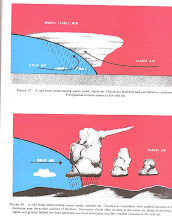
Clouds are also indicative of the type of air mass present (artic, polar, tropical, etc.) and fronts, either cold or warm. A front is a meeting of two dissimilar air masses. Air Masses and Fronts will be discussed in detail in the near future. RS.

Monday, June 18, 2007

Take a Break Chat

Readers: Between articles and blogs, let's chat a bit. I must tell you that I am sentimental and occasionally launch into philosophical tidbits. I've learned a lot of things in my life beside aviation, three of which I think you should hear: 1. Love is what makes the world "go around", it is our life. We can't do without it. It is the eliminator of hate and anger, and it gives us the courage and confidence to accomplish our tasks. 2. Giving is the one true happiness. Give of yourself and then remember the forgotten and the needy. Giving will relieve your stress and tensions, and allow you to face all the problems of the world with complete confidence. 3. There's no substitute for a good nights' sleep.

I had to tell you this, also - I love swing music and melodic songs. Tony Bennett's "I left my heart in San Francisco" is a particular favorite and Russ Morgan's "So Tired" is another. My wife and I used to dance to Russ Morgan's music at the Claremont hotel in Berkeley, CA. Natalie Cole's "Unforgettable" and Dinah Washington's "What a difference a day makes" will stop me cold. What are your preferences?