Ceiling and visibility are two basic weather elements which must be considered in all flying beginning with your flight planning. Normally we don't give the two elements much thought. We look at the sky - it's either cllear or cloudy. And we look out and around to see how far we can see objects. But for flying, the broad perspective must be narrowed to specific judgments.
The FAA's definition of ceiling is "the height above the earth's surface of the lowest layer of clouds or obscuring phenomena that is reported as broken, overcast, obscuration, and not classified as thin or partial". Pretty wordy and a little confusing, yes?
Well, let's get practical - if you cannot see clouds in the sky or you have something like fog or haze, you have either no ceiling at all or you have ceiling zero, depending on whether the condition is thin or heavy in obscuration.
Weather Observers classify clouds 3/10 or less as scattered, 6/10 as cloudy or a ceiling, 10/10 as overcast. And, of course, heavy fog would be obscuration or ceiling zero.
Now visibility is another matter. We usually think of seeing objects in terms of miles (statute), say 1/4 mile, 1/2 mile, 1/ mile, 3 miles, etc., a matter of distance judgment - relating much to visual acuity used in connection with takeoff, landing, and clearances, and VFR and IFR flight. In fact, ceiling and visibility appears as the first pair of elements used in our flight planning.
As stated (all too simply) in the FARs (Federal Air Regulations), IFR flight is weather conditions below the minimums for flight under VFR conditions.
In any case, to the pilot ceiling means dealing with clouds, sky cover, at what altitudes, and their movement over time. Visibility relates to all kinds of weather conditions - rain, snow, fog, smoke, and haze in connection with all phases of flight and appears perhaps as the first defining factor in planning whether you fly VFR or IFR.
Sunday, June 3, 2007

Saturday, June 2, 2007
My Novel
You didn't know that I wrote an aviation-romance novel, did you?
The title is : "Justin's Way Back" and it's about an America World Airlines Captain who flys the new Boeing 777 (home base San Francisco) to continental and overseas destinations while his wife gets mixed up with a mobster. He doesn't take it well and slips a little until Amanda and Josephine come along, with some other people, too. You must like flying, and romance, too.
It's a soft-cover book of 432 pages selling for $12.95 plus Calif. tax. You can obtain a copy by
E-mailing me at: ( roberthshaw@sbcglobal.net). RS.
Need More Pilots
Good Morning fellow pilots and all others! And as my father-in-law used to say, "And the rest of the day to you, Sir!"
I had planned on discussing Ceiling and Visibility today, but I've thinking about our pilot population - we need pilots now and for the future. I've been told that we will lose 3,000 airline pilots in the next 2 years due to forced age retirement. At this point in time I don't see where the replacement pilots are coming from. I don't think we have the Aviation schools and Instructors to provide the need for the replacement pilots and the call for future pilots.
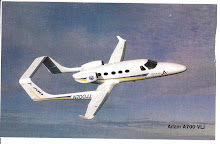
And - in my opinion the future looks bright for all pilots, especially in the jet world, particularly in the very light jets (vlj) for beginning pilots, which seems to be developing by leaps and bounds. The developing jet world, with its advancement of digital equipment, will require more and more aviation and electronic technicians and many types of qualified Instructors. And the latest models of the Prop and prop-jet airplanes are being installed with the new advanced equipment.
Yes, Aviation is in a stage of development - we now have several Universities and colleges offering Bachelor and Masters degrees in Aviation on the Internet.
Aviation is an equal opportunity employer - it's not just for the male. You know we have many employed female Airline Captains and First Officers right now - and they make good money, too.
Let's think about our future in Aviation! Give me a digital buzz of your thoughts!
Wednesday, May 23, 2007
An Ode To Veterans - Husbands
(Dedicated to my wife and all her talented sisters of the Dames Club who are trying so desperately to practice the Arts and Sciences)
Fellows, even though we have man things to do and dare not pause
too long from our way, let us digress a moment and consider what
I have to say.
Listen carefully, for I'd like to speak of our wives and what they do,
especially those wives whose husbands go to school.
Though they all come from diverse sections and have different names,
they are sufficient alike to speak of them as one and the same.
Some wives knit and sew, cook and plan,
care for the baby, and do twice as much as any man.
Others Play solitaire and bridge, make gadgets and lamps,
and wish to hell they wore the pants.
And even some pull their hair, rave, and just can't take it.
Now fellows, this is a tough life for them,
they don't really like it and often complain,
some are frustrated, neurotic, and others almost insane,
yet, they do the best they can.
At times I feel happy and glad, other times mad and sad,
perhaps it would be best to send her home to Mother and Dad.
But harken, fellows, even though it is trying at times,
don't give up for the hand of GOD it will be over soon,
at least it will be for me; with the best of luck I'll graduate in June.
Robert Shaw
P.S. I wrote this many years ago while attending Air Force radar
School. You can critisize it if you like.
Tuesday, May 15, 2007
VFR Flying AT Night
VFR flying at night has its hazards, especially for the beginning private pilot - hazards that are not easily recognized and appear rather suddenly - especially transitioning from day flight to night flight.
Okay, what is night flight? Let's start with FAA's perception of night flight as detailed in
Part 61.57 of th FAA Regulations - "the time between the end of evening civil twilight and the beginning of morning civil twilight, as published in the American Air Almanac, coverted to local time".
Okay, then, what is twilight? On the ground (or airport) twilight is the time between sunset and complete darkness.
At altitude twilight appears as daylight until the sun disappears from your vision. With no clouds you can see the sun setting while you are still in bright daylight (it's a beautiful sight). You keep flying and all of a sudden the sun has disappeared and you are in darkness. There may be lights but (surprise, surprise) your horizon has disappeared. You must now refer to your instruments.
The important thing to recognize and remember is that night flight requires a reference to the ground and the horizon (airport beacons, city lights, airway lights, etc.) to maintain level flight. If you lose that reference, you must use your instruments (attitude and directional displays).
The transition from daylight to darkness in flight can be unsettleing if you havent given it prior thought. Normally, the pilot does not think about night flying being a problem since he is already busy with communications and en route and weather considerations. But, let me advise you, on cross-country flights you will find some areas in complete darkness, requiring flight solely by instruments.
And before long - you will probably decide to get your instrument rating.
Tuesday, May 8, 2007
Altimeter Settings
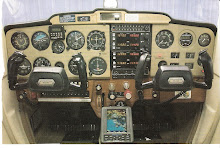
Altimeter settings is a subject usually not discussed in any great detail and one has to put altimeter errors and atmospheric temperature and pressure standards together to get the true picture of why we have to keep resetting the altimeter as we fly.
Let's look at it this way: The standard temperature at sea level (s.l.) is 59 degrees Farenheit (F.) and the temperature decreases with altitude at a gradient of 3.6 degrees/1000 feet (ft).
So as we gain altitude we have to apply a temperature correction.
The atmospheric pressure also decreases with altitude (roughly 1 inch Hg/1,000 ft) and is subject to high or low pressure areas that travel across our continents.
Since the accuracy of airplane altimeters is subject to changes in temperature and pressure, static pressure systems and instrument errors, a set of procedures must be used to maintain conformity of altitude for all airplanes in flight.
Above 18,000 ft. - A standard altimeter setting of 29.92 in. of Hg is used by all.
Below 18,000 ft. - When the barometric pressure is 31 in. Hg or less, the altimeter shall be set in accordance with a station along the route of flight, within 100 nautical miles of the aircraft.
VFR Flight - The pilot must set his altimeter at departure (the station) and en route (stations).
IFR Flight - FAA traffic Controllers will furnish the pilot with a current setting at least once while the aircraft is in the Controller's area of jurisdiction.
No Radio Flight - Set the altimeter at the departure airport.
Altimeter instrument Error - Any scale error should be detected by the pilot when he climbs into the cockpit: Then,
1. Set the current reported altimeter setting (airport).
2. The altimeter should now indicate the field elevation in altitude.
3. If not, note the variation from the known elevation. If the variation is plus or minus 75
feet, the accuracy of the altimeter is questionable.
In flight, obtain frequent current altimeter settings along your route because the weather keeps changing (Temp. and Press.) as you fly.
Flying from a high pressure area to a low pressure area - your airplane will be lower to the surface than your altimeter indicates.
Flying from a low pressure area to a high pressure area - your airplane will be higher above the surface than your altimeter indicates.
In any case, reset your altimeter to the setting given by the Tower before you land. Usually the ATIS has the current setting. What is ATIS? ATIS is an automatic terminal information service available to pilots on arrival at their destination, giving the pilot pertinent advisories such as altimeter setting, runway in use, current weather, etc.
We'll take up ATIS later as a subject for discussion. RS.
Sunday, May 6, 2007
70th year anniversary of the Hindenburg Fire
Memories! This is May 6, 2007 - I just read (in the Modesto Bee of Modesto, Ca.) Chris Newmarkers story - Assoc. Press. - about Robert Buchanan of Tuckerton, N.J. - a survivor on the field at Lakehurst during the Hindenburg fire May 6, 1937.
I, too, was on the field that evening. Another U.S. Navy Sailor, myself, an an unidentified civilian worker rescued Captain Max Pruss and Captain Lehmann as they fled from the fiery wreckage.
I was 20 years old then, attending the US Navy Aerographers School.
If you are interested - I wrote a 17-page article on the Hindenburg Fire , which at this time has not been published. I'll never forget that night! RS.
Subscribe to:
Posts (Atom)