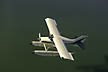
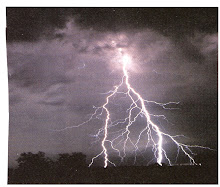
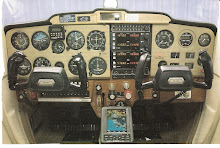
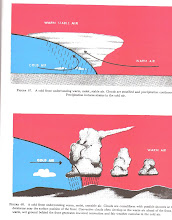
Hi Readers: Aviation Weather Services promolgated by the FAA, the NWS, and NASA are best described by and necessarily involve the actual flight, local or x-c, VFR and IFR flight plans; beginning with flight planning, and leading to en route flight, and terminating with descent and approach to land. In addition, the Weather Services provide an assist to the Controllers in preparing for the duties in which they are charged. Even local flights must be considered in terms of current weather - often pilots on local flights are caught in a sudden change of weather from VFR to IFR, as many of the aircraft accidents reveal.
Weather is a 24-hour phenomenom, in constant change of its elements and phases. In 20 minutes a cloud ceiling may ascend or descend 2,000 feet, precipitation can change from rain to ice, and visibilities can become obscured or obliterated.
Since most weather services are tied to a specific phase of flight, let's plan a VFR x-c flight. Without getting into the details, we would either file a flightplan with AFSS/FSS by telephone using TIBS (Telephone Information Briefing Service), a recording of the destination current weather, or talking with a weather specialist concerning the destination current and forecasted weather (1-800-WxBrief- toll free). This is a Preflight Briefing to help the pilot determine a "go" or "no go" decision. Or, if you are computer-oriented, you may file a flight plan with DUATS(Direct User Access Terminal System) - toll free, and get alpha-numeric preflight weather data and file a domestic VFR or IFR flight plan.
We might use, in conjunction with our flight plan or separately, METAR (Aviation routine weather report) or an FA(an area forecast), if advantageous.
After takeoff, we are considered in an en route phase of flight and can utilize several services to our advantage.
Lest we forget, we can still communicate with AFSS/FSS on a common frquency of 122.2 or a discrete frequency for an individual station to file, activate, close, or change a flight plan; request an IFR clearance, contact ATCT/ARTCC for control; file position reports, pass PIREPS (Pilot weather reports); request status of Special Use Airspace; and request assistance in an inflight emergency.
Normally, we might use EFAS (En Route Flight Advisory Service) for nonroutine weather needs in flight or TWEB ( Transcribed Weather Broadcasts) for the routine weather needs in flight. Inflight advisories include SIGMET (Significant Meteorological Information), Convective SIGMETs, AIRMETs (Airmen Meteorological Information), FAs (Area Forecasts) , Winds Aloft Forecasts (176 locations in 48 States), and PIREPs (Reports by pilots of weather conditions in flight).
Descending from en route flight to approach and landing at our destination we might use any number of weather advisories, primarily that concerning the weather at the destination airport or terminal such as FA, LLWAS (Low level wind shear alert system), PIREPs, TAF(Terminal Area Forecast), and WW (Severe Weather Watch). And, of course, our continued communications, depending on VFR or IFR, with ARTCC, TRACON ( Terminal Radar Approach Control), ATCT, and following with GT (Ground Control) to the very end of our flight.
ATCT and TRACON both use air/ground communications, visual signals, and other devices to provide ATC services to aircraft operating in the vicinity of an airport. ATC services authorizes aircraft to land or takeoff at the airport controlled by the tower or to transit the Class D airspace area regardless of flight plan or weather conditions. A tower may also provide approach control services.
To put the aviation weather services in perspective, the pilot must deal with ARTCC, ATCT, and TRACON (as spelled out in AC 00-45F) with respect to their flight plan to effect location and positive control of the aircraft. TRACONs manage the airspace 10 to 400 miles outside of selected airports and below 13,000 feet. They also coordinate spacing as aircraft approach and depart airports. Terminal Controllers are knowlegeable of current weather conditions and are prepared to advise pilots of hazardous weather conditions within a 150 nm sector or area. Tower operators are certified to act as official weather observers.
The December 2007 aircraft Accident Accounting is in process.
Thanks for listening. R.S.
Showing posts with label IFR flying. Show all posts
Showing posts with label IFR flying. Show all posts
Thursday, January 3, 2008

Thursday, November 15, 2007
October 2007 aircraft Accident/Incidents
Hi Readers: It time to review the October Accidents/Incidents as reported by NTSB ( There were none reported for Oct 1, 30th, and 31st).
Therewere 74 accidents (4 incidents)( 3 non-U.S. accidents) of which 23 were fatal accidents accounting for 48 fatalities. One fatal accident occurred in Venezuela, accounting for 2 fatalities; one fatal accident occurred in Switzerland, accounting for 2 fatalities; and one Beech D55 accident (1 fatality) occurred near St.Croix, Virgin Islands - apparenty encountering IFR weather. Twenty fatal accidents occurred in the Continental U.S. accounting for 43 fatalities.
There were 4 Incidents during October - one, an Airbus 320 landing at Fargo, North Dakota with the nosegear turned 90 degrees, incurring minor damage; another, an Airbus received minor damage after landing when it struck a runway light at Chicago O'Hare Intl airport. In another incident, classified as a pilot deviation, a Cessna 525 made takeoff from Taxiway M, rather than Runway 36L, at Memphis Intl airport against Controller instructions. In the 4th incident a Bell Helicopter made a forced landing in the Gulf of Mexico.
There were 4 balloon landing accidents at Albuquerque, New Mexico - all during the International Balloon Fiesta, and all striking objects on landing (due to wind and gusts) resulting in one fatality, 7 serious injury, and one minor injury.
There was one amateur-built gyroplane accident (one fatal, one serious injury) due to engine failure and resulting in impact with trees. One glider crashed during day VFR maneuvering (one fatal). A formation flight of Yakovlev Yak50 aircraft landing atGillespie Field, El Cajon, CA. resulted in a collision of 2 aircraft on the landing runway; and a Piper PA-32R collided with a Cessna 152 in the traffic pattern at Farmingdale, New York - there were no injuries.
The remaining fatal accidents were a conglomeration of day and night flights - an interesting study of accident causes and safety aspects: To begin, there was a 10-fatal Cessna 208B Caravan propjet on a 402 mile VFR night flight (returning 9 skydivers from a skydiving event near Boise, Idaho to a home base in Shelton, Wa.) that crashed about 45 miles WSW of Yakima, WA. at about 4,300 ft. msl, just south of Mt. Ranier, in IFR weather. There were indications of a rapid descent (6,800 ft/min) from 8,900 ft. and a power-on impact with mountainous terrain at 4,300 ft. msl. Low clouds, misty rain, and low visibility were reported in the area of the accident site, and a hunter in the area observed the aircraft first on horizontal flight, followed by vertical flight. Icing and loss of control were indicated.
The FAA reported that no service was provided to the pilot, there was no flight plan, and there was no record of a preflight or other weather briefing. The report noted VFR weather conditions generally along the route of flight, but IFR conditions in the Cascade mountains and western foothills. There was an AIRMET for icing, low-level turbulence, and mountain obscuration. (I can't imagine a Commercial pilot based at Shelton, Wa. not being clued-in on the weather, in that area, particularly in October). This particular airplane was equipped with analog gauges and digital avionics, including autopilot, GPS, transponder, and de-icing boots. The Mode C transponder was operating and FAA radar was tracking the airplane and observed the target, first at 14,400 ft, then at 13,000 ft, and then 8,900 ft, all in a matter of seconds. The NTSB and Cessna Aircraft are investigating the accident. In armchair analysis (based on what has been reported), I would have to say, in spite of the analog and digital instrumentation of the airplane, that this pilot demonstrated how not to conduct a VFR night x-c flight.
A second accident (5 fatal) involved a Beech A36 forced landing on takeoff and impact with power lines during variable direction and velocity of high winds and gusts. The aircraft was unable to gain altitude and maintain climb speed. Witnesses reported a rough engine. The pilot was IFR qualified and an IFR flight plan had been filed. Visual flight conditions existed. I wonder if this airplane was overloaded.
The remaining fatal accidents (11) involved an Aero Commander 560F (4 fatal) that impacted terrain after takeoff with a possible engine failure; a Rathyeon C90A (3 fatal) on a night VFR Medical flight which crashed during en route descent; a Cessna 310N (2 fatal) at 13,000 ft in icing conditions with an engine problem; a Cessna 150L (2 fatal), an Instructor and student, impacted terrain during takeoff climb - loss of power and loss of control indicated; a Piper PA-28 (2 fatal) on a night VFR x-c flight encountered IFR conditions and impacted trees and the ground; a Piper PA-28 impacted terrain on a night flight to Las Vegas - encountering IFR conditions; a Piper PA-18 collided with powerlines on a day VFR flight; A Bellanca 7GCBC aircraft crashed on a day VFR x-c flight - an outer wing failure indicated; and another Bellanca 7GCAA crashed due to loss of control following a tailwheel shimmy during a glider-tow operation; an Amateur-built Lambert Variez aircraft crashed during the pilot's test of an installed speed brake; and a Piper PA-18 collided with power lines on a VFR flight.
The October accidents indicate loss of control associated with aircraft and weather factors, along with doubtful flight planning and en route weather knowledge and awareness. Icing conditions, which can appear at any time of the year, seem to be a particular problem to pilots. Knowing the freezing level in weather and how to avoid the icing conditions is of the utmost importance. Pilots should learn how to use all the available weather, and weather-forecasting services, prior to and during en route flight. And, in spite of advanced instrumentation and the services available, pilots will always have to make the decision to fly or stay, or to choose an alternate, or land at the first available airport - and it may not be easy.
Thanks for listening. R.S.
Therewere 74 accidents (4 incidents)( 3 non-U.S. accidents) of which 23 were fatal accidents accounting for 48 fatalities. One fatal accident occurred in Venezuela, accounting for 2 fatalities; one fatal accident occurred in Switzerland, accounting for 2 fatalities; and one Beech D55 accident (1 fatality) occurred near St.Croix, Virgin Islands - apparenty encountering IFR weather. Twenty fatal accidents occurred in the Continental U.S. accounting for 43 fatalities.
There were 4 Incidents during October - one, an Airbus 320 landing at Fargo, North Dakota with the nosegear turned 90 degrees, incurring minor damage; another, an Airbus received minor damage after landing when it struck a runway light at Chicago O'Hare Intl airport. In another incident, classified as a pilot deviation, a Cessna 525 made takeoff from Taxiway M, rather than Runway 36L, at Memphis Intl airport against Controller instructions. In the 4th incident a Bell Helicopter made a forced landing in the Gulf of Mexico.
There were 4 balloon landing accidents at Albuquerque, New Mexico - all during the International Balloon Fiesta, and all striking objects on landing (due to wind and gusts) resulting in one fatality, 7 serious injury, and one minor injury.
There was one amateur-built gyroplane accident (one fatal, one serious injury) due to engine failure and resulting in impact with trees. One glider crashed during day VFR maneuvering (one fatal). A formation flight of Yakovlev Yak50 aircraft landing atGillespie Field, El Cajon, CA. resulted in a collision of 2 aircraft on the landing runway; and a Piper PA-32R collided with a Cessna 152 in the traffic pattern at Farmingdale, New York - there were no injuries.
The remaining fatal accidents were a conglomeration of day and night flights - an interesting study of accident causes and safety aspects: To begin, there was a 10-fatal Cessna 208B Caravan propjet on a 402 mile VFR night flight (returning 9 skydivers from a skydiving event near Boise, Idaho to a home base in Shelton, Wa.) that crashed about 45 miles WSW of Yakima, WA. at about 4,300 ft. msl, just south of Mt. Ranier, in IFR weather. There were indications of a rapid descent (6,800 ft/min) from 8,900 ft. and a power-on impact with mountainous terrain at 4,300 ft. msl. Low clouds, misty rain, and low visibility were reported in the area of the accident site, and a hunter in the area observed the aircraft first on horizontal flight, followed by vertical flight. Icing and loss of control were indicated.
The FAA reported that no service was provided to the pilot, there was no flight plan, and there was no record of a preflight or other weather briefing. The report noted VFR weather conditions generally along the route of flight, but IFR conditions in the Cascade mountains and western foothills. There was an AIRMET for icing, low-level turbulence, and mountain obscuration. (I can't imagine a Commercial pilot based at Shelton, Wa. not being clued-in on the weather, in that area, particularly in October). This particular airplane was equipped with analog gauges and digital avionics, including autopilot, GPS, transponder, and de-icing boots. The Mode C transponder was operating and FAA radar was tracking the airplane and observed the target, first at 14,400 ft, then at 13,000 ft, and then 8,900 ft, all in a matter of seconds. The NTSB and Cessna Aircraft are investigating the accident. In armchair analysis (based on what has been reported), I would have to say, in spite of the analog and digital instrumentation of the airplane, that this pilot demonstrated how not to conduct a VFR night x-c flight.
A second accident (5 fatal) involved a Beech A36 forced landing on takeoff and impact with power lines during variable direction and velocity of high winds and gusts. The aircraft was unable to gain altitude and maintain climb speed. Witnesses reported a rough engine. The pilot was IFR qualified and an IFR flight plan had been filed. Visual flight conditions existed. I wonder if this airplane was overloaded.
The remaining fatal accidents (11) involved an Aero Commander 560F (4 fatal) that impacted terrain after takeoff with a possible engine failure; a Rathyeon C90A (3 fatal) on a night VFR Medical flight which crashed during en route descent; a Cessna 310N (2 fatal) at 13,000 ft in icing conditions with an engine problem; a Cessna 150L (2 fatal), an Instructor and student, impacted terrain during takeoff climb - loss of power and loss of control indicated; a Piper PA-28 (2 fatal) on a night VFR x-c flight encountered IFR conditions and impacted trees and the ground; a Piper PA-28 impacted terrain on a night flight to Las Vegas - encountering IFR conditions; a Piper PA-18 collided with powerlines on a day VFR flight; A Bellanca 7GCBC aircraft crashed on a day VFR x-c flight - an outer wing failure indicated; and another Bellanca 7GCAA crashed due to loss of control following a tailwheel shimmy during a glider-tow operation; an Amateur-built Lambert Variez aircraft crashed during the pilot's test of an installed speed brake; and a Piper PA-18 collided with power lines on a VFR flight.
The October accidents indicate loss of control associated with aircraft and weather factors, along with doubtful flight planning and en route weather knowledge and awareness. Icing conditions, which can appear at any time of the year, seem to be a particular problem to pilots. Knowing the freezing level in weather and how to avoid the icing conditions is of the utmost importance. Pilots should learn how to use all the available weather, and weather-forecasting services, prior to and during en route flight. And, in spite of advanced instrumentation and the services available, pilots will always have to make the decision to fly or stay, or to choose an alternate, or land at the first available airport - and it may not be easy.
Thanks for listening. R.S.
Subscribe to:
Posts (Atom)